


Understanding how living organisms use energy is fundamental to biological research. Whether scientists are studying plant physiology, animal metabolism, or environmental processes, direct measurements of biological activity are often difficult. Measuring the exchange of biologically important gases between organisms and their environment allows real-time and noninvasive monitoring of key biological processes. In particular, measurements of oxygen (O₂) and carbon dioxide (CO₂) exchange allow measurements of photosynthesis, respiration, and energy expenditure across a wide range of biological systems.
Why Gas Exchange Measurements Are Fundamental
In plant science, researchers often want to estimate the net rate of carbon assimilation over a growing period. In human physiology, scientists may want to determine how much energy a person expends during exercise. In both cases, measuring these processes directly can be difficult.
Instead, researchers measure gas fluxes as indicators of biological activity.
For plants, the exchange of carbon dioxide and oxygen between leaves and the atmosphere allows scientists to estimate rates of photosynthesis and respiration. In animals and humans, the rates of oxygen consumption and carbon dioxide production can be used to estimate metabolic rate and energy expenditure using methods of indirect calorimetry.
Other biologically important gases also play important roles in research. Hydrogen is produced as a by-product of nitrogen fixation in legumes and by bacteria in the digestive systems of animals. Methane is generated by methanogenic microbes in ruminants and produced by anaerobic respiratory processes in wetlands, whereas nitrous oxide is produced during nitrification and denitrification processes in soils and biological systems.
Carbon dioxide, methane, and nitrous oxide are among the major greenhouse gases associated with climate change, making accurate measurement of these gases increasingly important in environmental science.
Digging Deeper into Oxygen and Carbon Dioxide Exchange Rates
Simultaneous measurements of oxygen and carbon dioxide exchange rates reveal important information about physiological processes in living organisms.
The familiar equation for photosynthesis shown in many textbooks is (see a clear overview of the process in this photosynthesis explanation)
6CO₂ + 6H₂O → C₆H₁₂O₆ + 6O₂
Respiration is essentially the reverse process:
C₆H₁₂O₆ + 6O₂ → 6CO₂ + 6H₂O
In photosynthesis, oxygen is produced during the light reactions when water molecules are split to replace electrons lost by chlorophyll, whereas carbon dioxide is fixed during the Calvin Cycle. If all the energy produced during light reactions were used solely for carbon fixation, the ratio of oxygen produced to carbon dioxide fixed would be one to one.
However, electrons generated from photosynthesis can also be used for other reductive processes. By measuring the ratio of CO₂ fixed to O₂ produced, researchers can estimate how much energy is being directed toward different biochemical pathways within plant tissues.
Gas exchange measurements are equally informative in animal physiology. During respiration, the metabolism of glucose produces one molecule of carbon dioxide for every molecule of oxygen consumed. When fats are metabolized, the ratio is reduced because fatty acids contain far fewer oxygen atoms relative to carbon atoms.
For example, when palmitic acid (C16H32O2) is metabolized, the ratio of CO₂ produced to O₂ consumed is approximately 0.7, a value known as the respiratory quotient (RQ). When measured by gas exchange methodology in human physiology RQ is referred to as the respiratory exchange ratio (RER). Measuring this ratio helps researchers determine which metabolic fuels, such as carbohydrates or fats, are being used during exercise.
During intense physical activity, the body may supplement aerobic respiration with anaerobic metabolism. When this occurs, carbon dioxide production increases faster than oxygen consumption. By continuously measuring oxygen consumption rate (VO₂) and carbon dioxide production rate (VCO₂), researchers can identify the anaerobic threshold, the point at which anaerobic metabolism begins to contribute to energy production.
Challenges in Measuring Gas Exchange
Designing accurate gas exchange systems presents several challenges. The fundamental relationship used to measure VO2 or VCO2 in most gas exchange measurements can be expressed simply as:
Rate (V) = Flow (F) × Gas Concentration Differential (D)
Here, F represents the flow rate of gas passing through a chamber containing the sample, and D represents the difference in gas concentration between air entering and leaving the chamber. At a fixed rate of gas exchange, as flow rate increases, the concentration differential decreases. Measuring low rates of exchange requires sensitive analyzers capable of resolving small gas differentials.
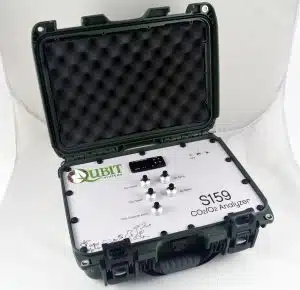
The expected metabolic rate of the organism being studied also influences instrument design. Larger animals with higher metabolic activity consume proportionately more O2 and produce proportionately more CO2 than smaller or less active animals. Systems such as Qubit’s High Range Respirometry Package, and instruments such as the S159 CO₂/O₂ Analyzer that monitor carbon dioxide and oxygen concentrations simultaneously are very valuable in studying the metabolism of rodents, livestock, and other animals.
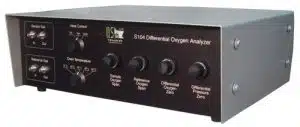
When monitoring metabolism in insects and photosynthesis in plants, the very small amounts of O2 exchanged make accurate measurements of O2 differentials challenging. Qubit developed the S104-DOX Differential O₂ Analyzer to address this problem. Unlike conventional oxygen analyzers, the S104-DOX measures extremely small oxygen concentration differentials with a precision comparable to low-range NDIR CO₂ analyzers. This allows researchers to monitor parameters such as photosynthetic quotient in plants and respiratory exchange ratios in very small animals and insects.
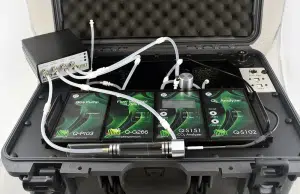
Another technique used in gas exchange research is stop-flow respirometry. In this approach, the sample is temporarily sealed inside a chamber during which oxygen consumption occurs without airflow. After a defined period, gas is flushed through the chamber and analyzed. The measured oxygen signal decline then recovers during the flush, and the “oxygen trough” is integrated to calculate the amount of oxygen consumed during the sealed incubation period.
Qubit’s Q-Box Low Range Respiration Package supports both open-flow and stop-flow measurement configurations, giving researchers flexibility when studying organisms with very low metabolic rates.
Advances in Gas Exchange Technology
Technological innovation continues to expand the range of measurements possible in biological research. Instruments such as differential oxygen analyzers and highly sensitive CO₂ analyzers allow researchers to study organisms that were previously difficult to measure.
New technologies such as cavity ring-down spectroscopy are also enabling the detection of trace gases such as nitrous oxide, opening new opportunities in environmental and agricultural research.
The Advantages of Gas Exchange Measurements
An important aspect of gas exchange measurements is that they are non-invasive. The organisms or tissues being studied remain unharmed during measurement, allowing researchers to monitor changes in the same sample over time without interfering with the biological system itself.
Because measurements can be made continuously, scientists can also observe how organisms respond to environmental changes or experimental treatments in real time. This ability to correlate metabolic responses with environmental or physiological conditions makes gas exchange measurements an essential tool across plant biology, animal physiology, environmental science, and human metabolism research.
For these reasons, gas exchange measurements remain one of the most powerful approaches for understanding how living systems function.