


It’s not surprising that scientific terminology gets co-opted by big business when there’s money to be made from the gullible. One of my favourite advertising slogans was for a shampoo made by Fabergé Organics back in the late 1980s, informing the (great unwashed) user that its magic formulation “Contains the Tetrahedral Carbon Atom — As in Nature!”
Who would have thought such a thing?
Nowadays, VO₂max measurement is being treated as the one metric everyone needs to keep an eye on if they wish to maintain their pole-vaulting career into their nineties. There is much truth in this — the scientific literature indicates that an increase in VO₂max of just 1 mL O₂/kg/min can reduce all-cause morbidity by 10%. But the claims made by social media snake-oil vendors are something else entirely. A recent post assured me that a simple exercise routine, barely involving a raised heart rate, would take me from 20 to 65 mL O₂/kg/min in just six weeks. In other words: from pillow-hugging lethargist to Tour de France pacer — by a process entirely unknown to biophysics.
At Qubit, we deal in scientific facts, no matter how cold and hard they may seem.
1. Your Smartwatch Is Not Doing VO₂max Measurement
Anyone with a smartwatch can navigate to a screen offering a VO₂max estimate. And an estimate is exactly what it is. Apple, Garmin, and their peers use proprietary algorithms to predict oxygen consumption at peak effort based on motion and heart rate — this is not VO₂max measurement in any rigorous sense. These values tend to be overestimated at the low end (providing some comfort for the couch potato) and underestimated at the high end, causing frustration for the diligent athlete.
2. Accurate VO₂max Measurement Requires Direct Gas Sampling
The only precise approach to VO₂max measurement is to sample the O₂ concentration of exhaled air directly. Some devices stop there. Others — typically at considerably greater expense — also measure CO₂ in exhaled breath. That CO₂ measurement matters more than it might seem: measuring O₂ alone provides less than half the fitness picture. The Respiratory Exchange Ratio (RER = VCO₂/VO₂) reveals the type of metabolic fuel being consumed (fat versus carbohydrate) and the critical point at which anaerobic respiration begins to supplement aerobic energy production. Without it, you’re reading one page of a multi-page story.
3. The Right Tool for VO₂max Measurement: Meeting Researchers at ACSM
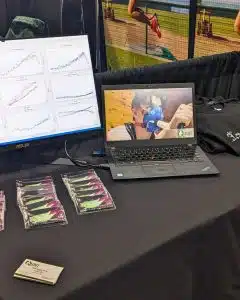
This is precisely what brought us to the American College of Sports Medicine (ACSM) Annual Meeting in Salt Lake City in May — and what will take us to the European College of Sport Science (ECSS) conference in Lausanne, Switzerland, in July.
At conferences like these, researchers, kinesiologists, and sports science specialists understand exactly what rigorous VO₂max measurement demands, and what training regimes are genuinely required to shift the needle from sluggard to athlete. It’s a refreshing crowd.
VOCO is Qubit’s wearable cardiopulmonary exercise testing (CPET) device, purpose-built for accurate VO₂max measurement in the field. It measures VO₂, VCO₂, heart rate, and breathing dynamics — giving the sophisticated user everything needed for a complete fitness analysis. Worn on the back and weighing just 1 kg, it can be used during most activities (synchronised swimming and competitive diving: not recommended), allowing complete freedom of movement.
Delegates at ACSM were impressed by its ergonomic design. They were also impressed by its current price: at $18,000 USD, VOCO is less than half the cost of most competing ambulatory CPET devices — and a fraction of the cost of laboratory-bound metabolic carts.


4. Why Inexpensive Doesn’t Mean Inferior
The question that always comes up: why so cheap? We prefer inexpensive — there is nothing cheap about VOCO, and nothing is compromised in its VO₂max measurement capabilities.
- We use a fuel cell O₂ sensor and an NDIR analyser for CO₂ — the same technologies found in systems costing considerably more.
- Frequent automated calibration ensures sensor drift is continuously corrected.
- Every VOCO is validated against a metabolic calibrator generating known values of VO₂, VCO₂, and RER before it leaves us.
- We provide full access to both RAW data and processed PARAMETER data — no hidden calculations, no black boxes.
- If you want to run your own algorithms, our software provides direct access to raw data for independent recalculation.
- The software generates 9-panel Wasserman plots automatically, and allows any measured or derived variable to be plotted against any other.
- Breath averaging and statistical analysis are included as standard.
If there’s something we’ve missed, we want to hear about it — and we’ll consider it for future VOCO releases as the product continues to evolve.
Learn more about VOCO here.
5. Beyond CPET: Whole-Body Indirect Calorimetry
For those who prefer to work with a human subject housed in a metabolic chamber — no facemask, no encumbrances, eating, sleeping, and exercising freely as energy expenditure is measured — Qubit also offers what we believe to be the world’s best system for whole-body indirect calorimetry. Our VO₂ signals have ten-times better resolution than any other system we’ve encountered, with excellent time synchronisation between activity and gas analysis. A different approach to VO₂max measurement and metabolic research, but the same commitment to precision.
Also on the Road: Society for Experimental Biology Conference, Florence
While VOCO takes centre stage at the ECSS in Lausanne, other Qubit scientists will be on the Qubit booth in Florence at the annual Society for Experimental Biology (SEB) conference (they’ve been fighting over who goes where — tough choices). At SEB, we’ll be exhibiting our metabolic measurement systems for plants, insects, animals, coral and other aquatic species, as well as gas analysis systems for soil respirometry and environmental monitoring. Different technology offered for different purposes, but with the same premise: accurate, dependable measurements at sensible prices.
Have questions about VOCO or any of our systems? Contact us — we are always happy to chat with people who Contain the Tetrahedral Carbon Atom, As in Nature.